

Professionals & Organizations
Professional & Organizational Readiness for Sport-Based Interventions
Understanding the People Who Turn Sport into Practice
The success of sport-based interventions for people experiencing homelessness depends not only on participants’ willingness to engage, but also on the professionals and organizations responsible for delivering them.
The GET-UP Study therefore examined whether professionals working within homelessness services possess the knowledge, practical skills, organizational support, resources, and motivation required to integrate sport-based life skills interventions into routine practice.
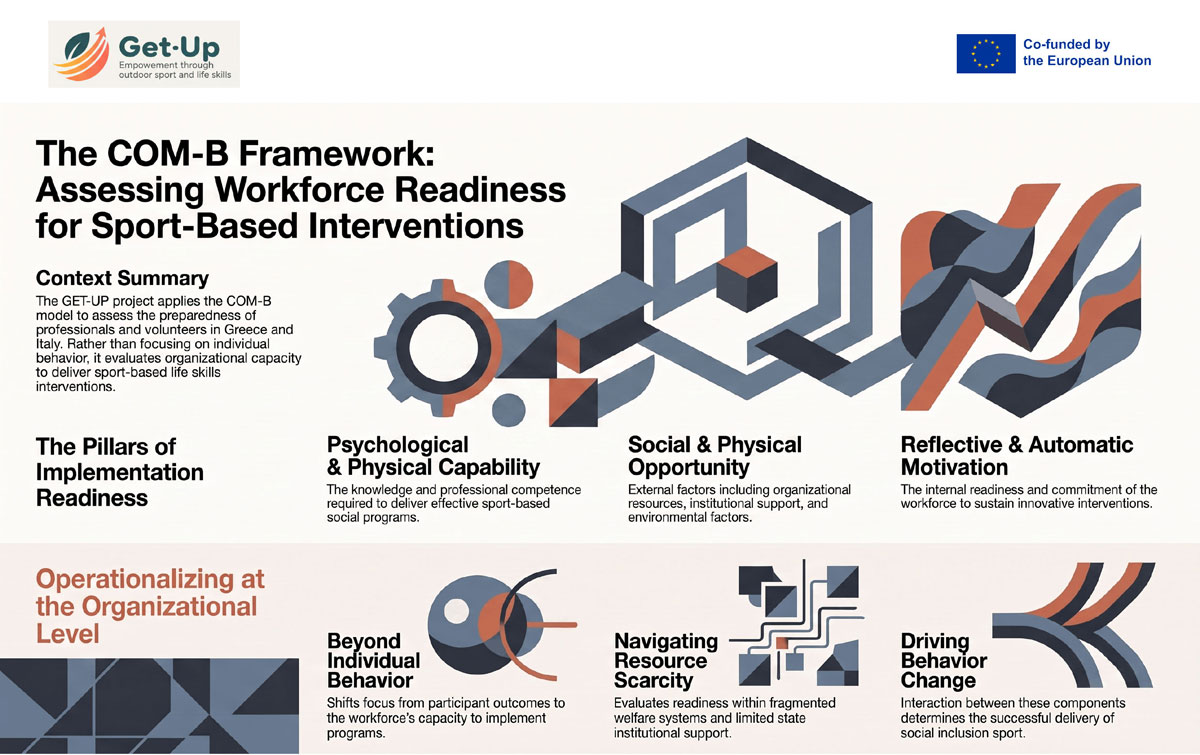
Rather than treating implementation as an individual responsibility, the study applied the COM-B framework to understand professional readiness through three interconnected dimensions:
Capability – Do professionals have the knowledge and skills required?
Opportunity – Do their organizations provide the time, resources, infrastructure, and support necessary?
Motivation – Do professionals value sport-based approaches and feel committed to using them?
The study included 81 professionals and volunteers working in homelessness services in Greece and Italy, complemented by 24 qualitative interviews. Participants represented a multidisciplinary workforce including social workers, psychologists, counsellors, educators, outreach workers, programme coordinators, sport trainers, shelter staff, volunteers, and other professionals.
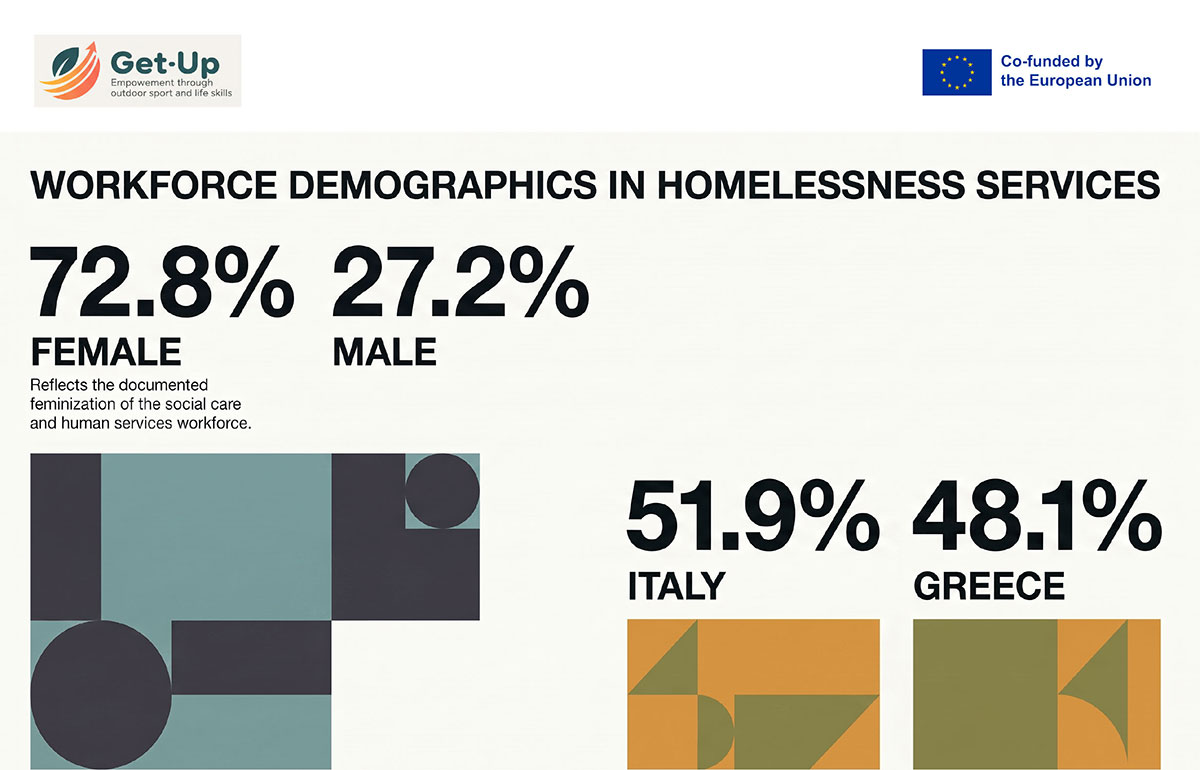
Who Participated? A Multidisciplinary Homelessness Workforce
Key Findings
The GET-UP professional study included 81 professionals and volunteers:
- Greece: 39 participants – 48.1%
- Italy: 42 participants – 51.9%
- Mean age: 42.05 years
- Women: 72.8%
- Men: 27.2%
Employment arrangements also reflected the diverse structure of homelessness services:
- 54.3% worked full-time.
- 21.0% were volunteers.
- 12.3% worked freelance.
- 12.3% worked part-time.
The workforce therefore combines permanent staff, specialized professionals, community practitioners, and volunteers within a highly multidisciplinary service environment.
Strong Understanding of Why Sport Matters
Key Findings
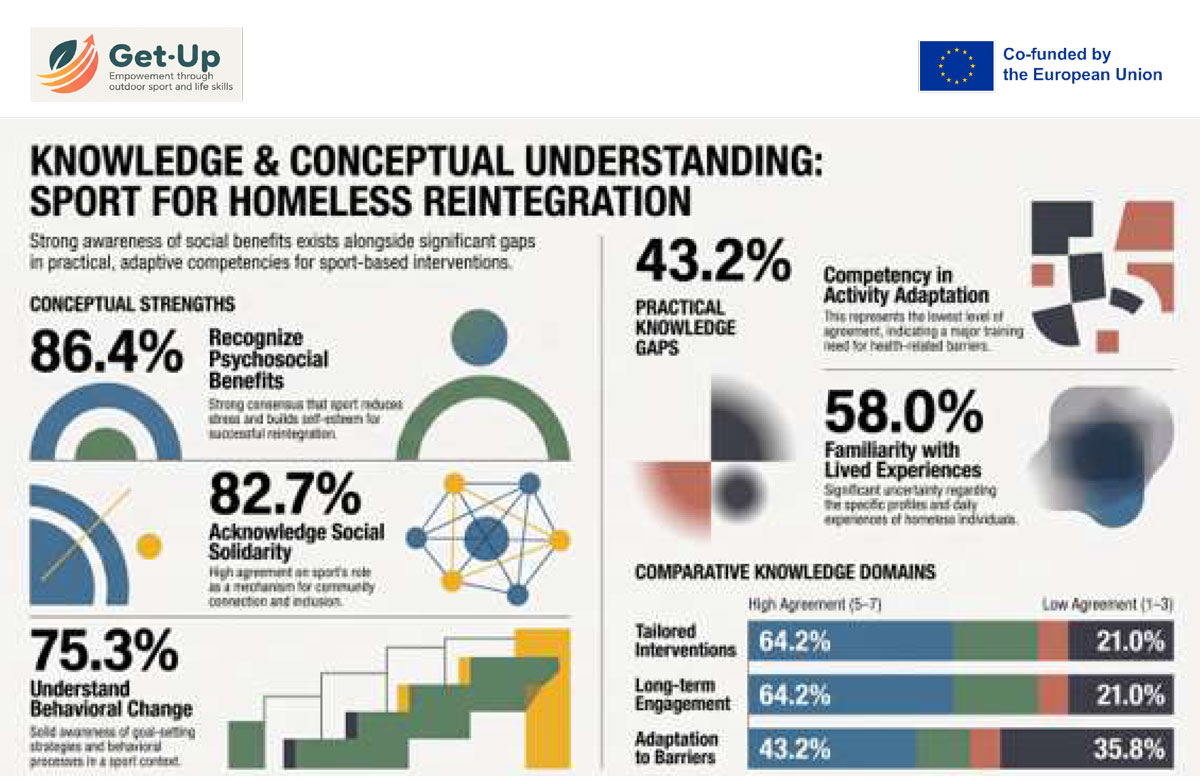
Professionals showed particularly strong knowledge regarding the potential contribution of sport to psychosocial wellbeing and social inclusion:
- 86.4% recognized that sport can reduce stress and strengthen self-esteem.
- 82.7% recognized sport as a means of strengthening community solidarity and social connection.
- 75.3% reported understanding behavioural change and goal-setting strategies.
- 64.2% understood processes supporting sustained engagement.
- 64.2% recognized the need for interventions specifically adapted to homelessness.
- 58.0% reported familiarity with the experiences and profiles of people experiencing homelessness.
However, confidence declined considerably when knowledge had to be translated into highly specialized practice:
- Only 43.2% felt capable of adapting activities to participants’ physical and mental health barriers.
This represents one of the clearest professional competency gaps identified by the study.
Strategic Implications
Training should not focus primarily on explaining the benefits of sport. Professionals already understand them.
Capacity building should instead concentrate on:
trauma-informed practice – mental and physical health adaptation – individualized programme design – behavioural engagement – safeguarding – risk-sensitive delivery.
The Implementation Skills Gap
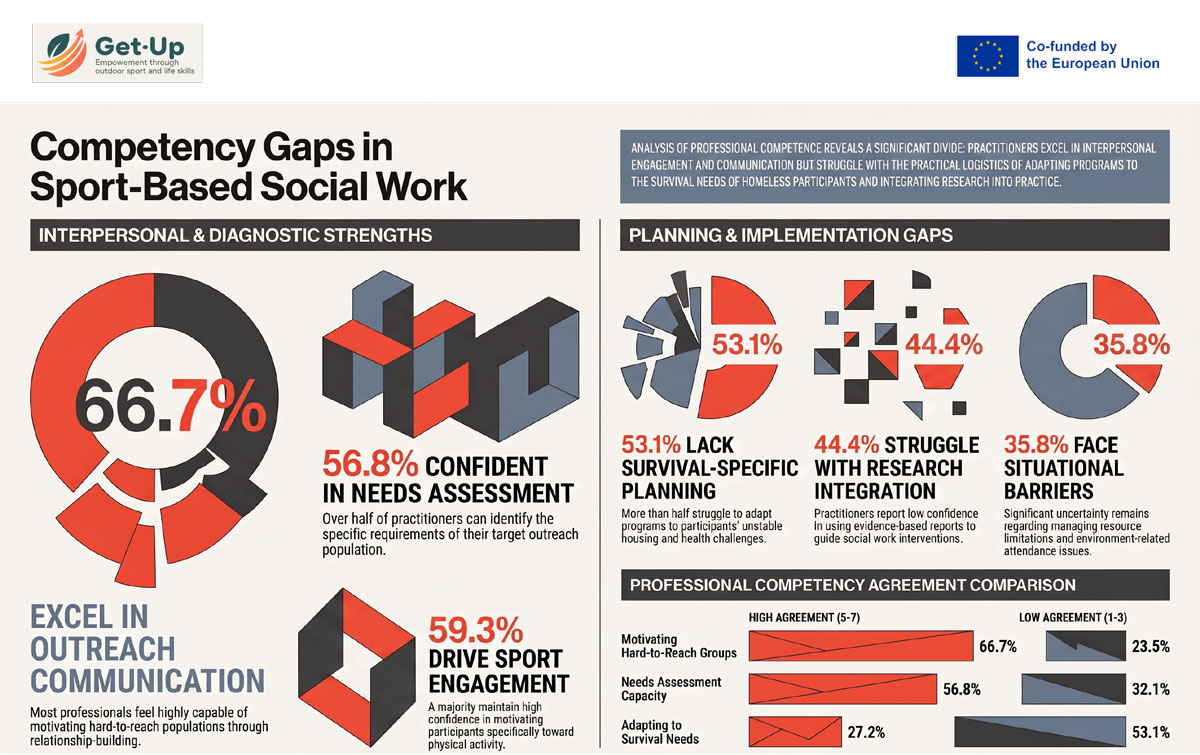
The strongest contrast in the professional findings appears between relational competence and technical implementation competence.
Professionals generally feel confident engaging vulnerable populations, but much less confident designing sport programmes that respond to homelessness-related instability.
Key Findings
Strong relational skills
- 66.7% felt confident in their communication skills for motivating hard-to-reach populations.
- 59.3% felt able to motivate people specifically to participate in sport.
These results demonstrate an important professional strength: homelessness practitioners already possess many of the interpersonal skills required to build trust, encourage participation, and establish supportive relationships.
Lower implementation competence
Only 27.2% felt confident planning sport programmes adapted to realities such as:
- unstable housing;
- poor health;
- transportation difficulties;
- food insecurity;
- unpredictable routines;
- inconsistent attendance.
By contrast, 53.1% reported low confidence in this area.
Needs-assessment competence was stronger, with 56.8% feeling capable of identifying participant needs.
Only 38.3%, however, reported confidence in using research evidence and professional reports to guide sport-based social work.
Strategic Implications
The central professional-development need is therefore not basic communication training.
Professionals need practical tools that help them move from:
“I can engage this person”
to
“I can design, adapt, deliver and evaluate an intervention that works within this person’s real-life circumstances.”
Training should therefore include:
programme adaptation, needs assessment, behavioural planning, evidence-informed intervention design, monitoring, evaluation, risk management, and contingency planning.
The Biggest Barrier Is Not Motivation — It Is Opportunity
The most important finding from the professional study concerns organizational opportunity.
Professionals may value sport and want to implement it, but sustainable delivery becomes extremely difficult when organizations do not provide the basic conditions required.
Key Findings
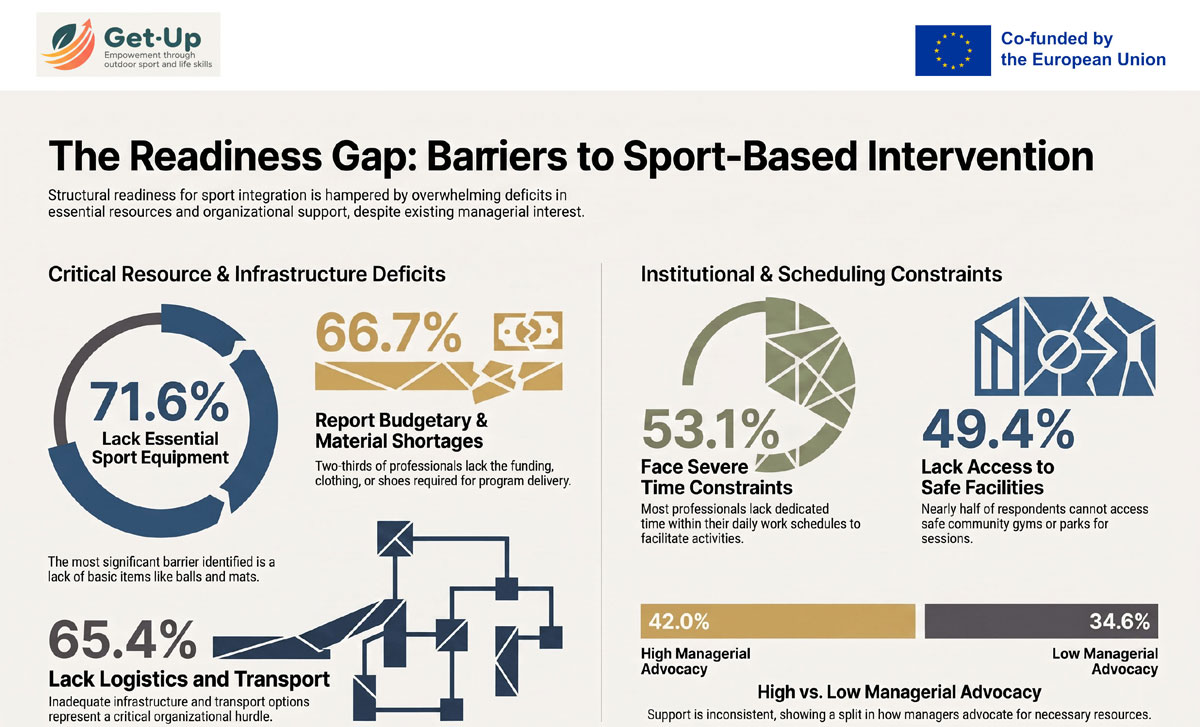
Major resource deficits were identified:
- Only 18.5% reported having adequate sport equipment.
- Only 19.8% reported access to sufficient financial and material resources.
- Only 23.5% reported adequate infrastructure, transportation, or sport-related resources.
- Only 33.3% reported sufficient access to safe facilities.
- Only 33.3% had enough time within their daily work schedules to facilitate sport-based activities.
Conversely:
- 71.6% reported insufficient equipment.
- 66.7% reported inadequate financial/material resources.
- 65.4% reported inadequate infrastructure and transport.
- 53.1% reported insufficient working time.
- 49.4% reported inadequate access to safe sport facilities.
Strategic Implications
The GET-UP findings strongly challenge the idea that poor implementation results from insufficient staff enthusiasm.
Professionals cannot implement what organizations do not structurally enable.
Effective implementation requires:
protected professional time + equipment + transport + accessible facilities + dedicated resources + organizational planning.
Without these conditions, sport programmes remain dependent on individual enthusiasm and are unlikely to become sustainable elements of homelessness services.
Professionals Believe in Sport — and Want Quality
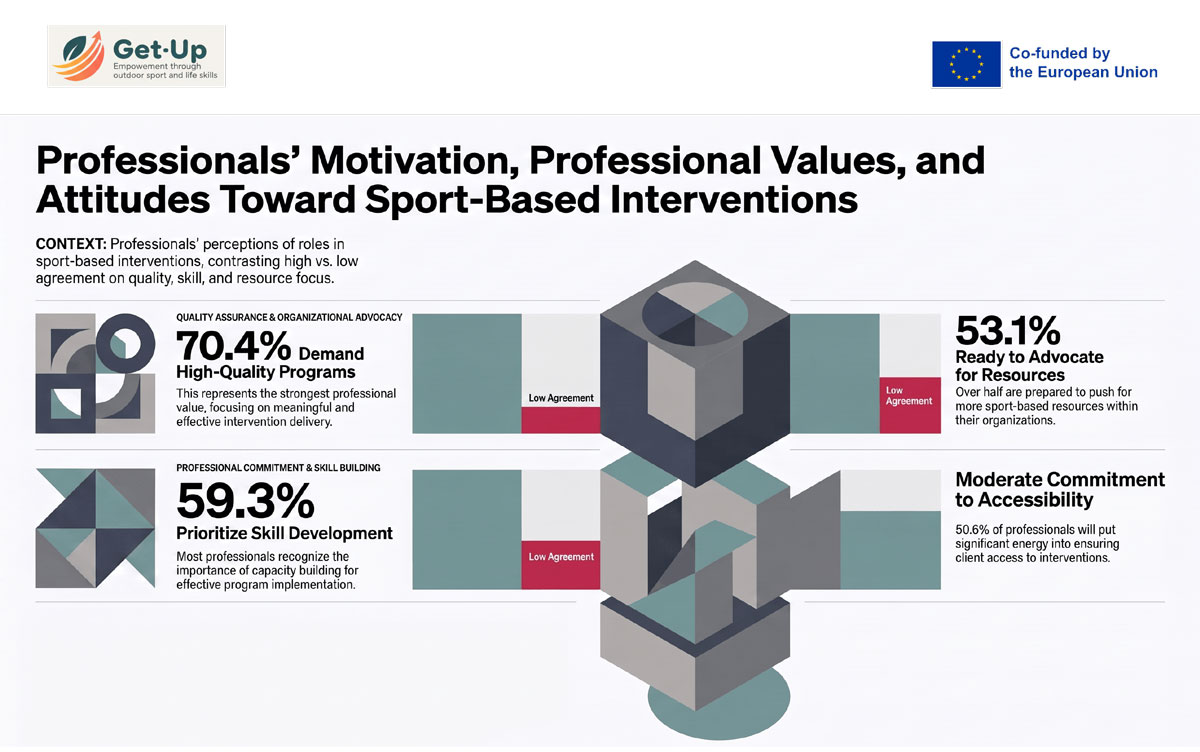
Despite significant structural constraints, professionals demonstrated a clearly positive motivational orientation toward sport-based interventions.
Key Findings
- 70.4% considered it important that sport programmes are high-quality and effective.
- 59.3% were willing to improve their skills in planning and evaluating programmes.
- 53.1% were prepared to advocate for greater sport-based resources within their organizations.
- 50.6% were willing to invest significant energy in making interventions accessible to clients.
Strategic Implications
The workforce does not need to be persuaded that quality matters.
Instead, organizations should convert this existing motivation into implementation capacity through:
structured training, supervision, implementation tools, organizational recognition, and clear delivery pathways.
In COM-B terms, the strongest implementation strategy is not simply to increase Motivation, but to align it with sufficient Capability and Opportunity.
Sport Is Valued as a Psychosocial Intervention — But Not Yet a Core Professional Role
The study also examined whether professionals were ready to integrate sport into everyday service delivery.
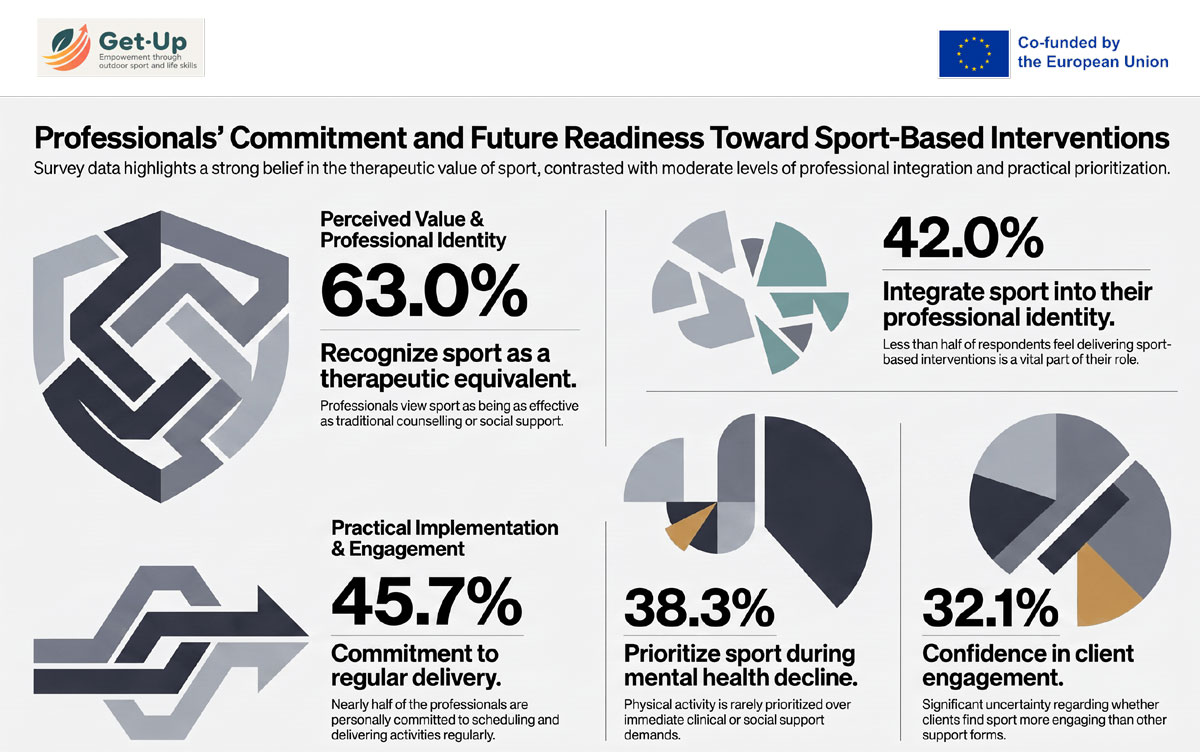
The findings reveal an important transition point: professionals increasingly recognize sport as therapeutically meaningful, but it has not yet become fully embedded within professional identity or routine practice.
Key Findings
- 63.0% believed sport could be as therapeutic as traditional counselling or social support.
- 45.7% were personally committed to scheduling and delivering sport-based activities regularly.
- Only 42.0% viewed delivering sport-based interventions as a vital part of their professional role.
- 38.3% prioritized physical activity when a client’s mental health was declining.
- Only 32.1% believed that clients find sport-based interventions more engaging than other forms of support.
Strategic Implications
These results reveal a clear recognition–implementation gap.
Professionals increasingly see sport as valuable, but many still regard it as an additional activity rather than a routine component of professional practice.
The next stage for homelessness services is therefore not simply to offer more activities, but to establish sport as part of:
assessment → individualized support planning → intervention → monitoring → social reintegration.
The Central Finding: A Readiness Gap
When quantitative and qualitative findings are combined, one conclusion becomes particularly clear:
Professionals generally believe in sport.
They are motivated to use it.
But they do not always have the skills and organizational conditions needed to implement it sustainably.
The study found that only 27.2% felt confident planning programmes adapted to homelessness-related survival realities, only 43.2% felt capable of adapting activities to physical and mental health barriers, only 23.5% had adequate infrastructure and transport, only 18.5% had sufficient equipment, and only 19.8% reported adequate financial resources.
This means the implementation problem should not be framed as a lack of professional commitment.
It is a Capability–Opportunity gap.
Strategic Implications
GET-UP therefore proposes a shift from:
“Train motivated professionals to run sport activities”
toward:
“Build professional and organizational systems capable of delivering sport-based psychosocial interventions.”